
TL;DR
Pharmaceutical regulations for deviation investigations are structured in three layers: statutes (legal authority), binding regulations like FDA 21 CFR or EU GMP laws, and technical guidance such as FDA OOS guidance, EU GMP Annexes, and ICH Q9/Q10. While regulations require that investigations are performed and documented, the actual methodology is largely defined by guidance and industry practice, which creates variability in investigation quality across organizations.
Key Takeaways
- 1Pharmaceutical regulatory systems follow a consistent three-layer structure: statute, regulation, and guidance.
- 2FDA 21 CFR and EU GMP laws define mandatory requirements, but are intentionally high-level.
- 3Guidance documents (FDA, EU GMP, ICH) define how investigations are actually conducted in practice.
- 4ICH Q9 and Q10 provide a harmonized foundation for risk management and CAPA across US and EU systems.
- 5Deviation investigation methodology is not prescribed by regulation — it is driven by guidance and industry convention.
- 6This gap is why investigation quality varies significantly across teams and organizations.
1. The Three Fundamental Layers Everywhere
Regardless of jurisdiction, every regulatory system for pharmaceutical manufacturing sits in three stacked layers that are easy to conflate but serve very different functions.
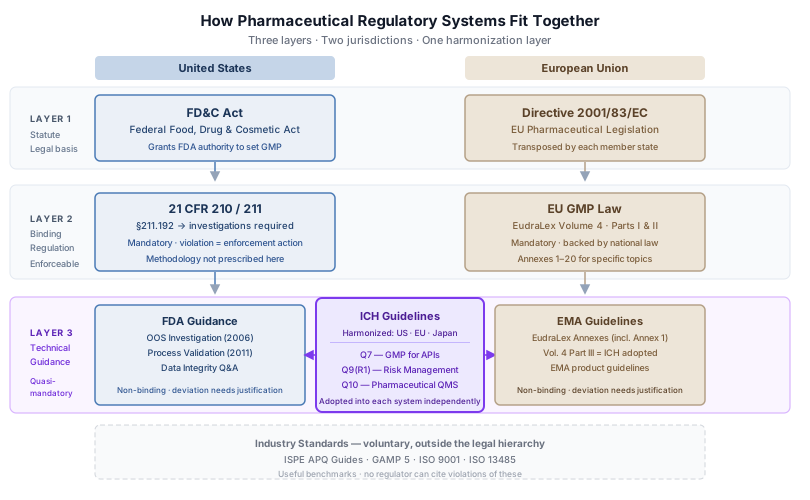
Layer 1 — The legal authority layer. This is the statute or primary legislation that gives the regulator the power to impose GMP requirements at all.
- US: Title 21 USC - Federal Food, Drug & Cosmetic Act (FD&C)
- EU: Directive 2001/83/EC (for human medicines) and its amendments
- UK (MHRA): Medicines Act 1968 (the primary statute; the Human Medicines Regulations 2012 are the Layer 2 statutory instruments made under it)
- Australia (TGA): Therapeutic Goods Act 1989
These documents don't tell you how to conduct an investigation. They simply establish that manufacturers must comply with GMP as a condition of market access, and they delegate the technical detail to a lower layer. You rarely read these in practice. Their job is to create the legal basis.
Layer 2 — The binding regulatory requirements layer. This is what actually has legal force. In the US, that's 21 CFR — regulations that FDA has promulgated through formal rulemaking under authority of the FD&C Act. Violation of 21 CFR can result in enforcement action. In the EU it's more nuanced: once a directive is transposed into national law by each member state, the national legislation is what's legally binding. EU Regulations (like Commission Regulation (EU) No 1252/2014 on API GMP principles) are directly applicable without transposition. Either way, this layer is what investigators mean when they say something is "a regulatory requirement."
Layer 3 — The technical guidance layer. This is where the actual "how to investigate" content lives. FDA guidance documents, EMA guidelines, the EU GMP Guidelines (EudraLex Volume 4), ICH guidelines, USP general chapters. These are generally not legally binding in the strict sense. But in practice, they function as quasi-mandatory because regulators inspect against them and deviation from them requires documented scientific justification. This is where the interesting design and practice questions live.
2. The US System
The hierarchy is clean. The FD&C Act creates FDA's authority. 21 CFR 210/211 are the binding GMP regulations for finished pharmaceuticals; 21 CFR 600-680 cover biologics; 21 CFR 820 covers medical devices — updated by the QMSR final rule (February 2024), which incorporates ISO 13485:2016 by reference, making the ISO standard the primary basis for device GMPs in the US rather than the prior QSR framework. For deviation investigations specifically, 21 CFR 211.192 is the operative provision — it requires written investigations of failures or discrepancies, extension to other batches, and a record of conclusions. It is deliberately sparse. The regulation doesn't specify an investigation methodology, timeline, or quality standard. That technical detail lives in guidance.
FDA guidance documents (the OOS Guidance of 2006, the Process Validation Guidance of 2011, the Data Integrity Q&A, the CAPA document) are explicitly non-binding. But don't be misled by that: an inspector who finds that you deviated from FDA guidance will expect a documented scientific rationale for why your alternative approach is at least equivalent. In practice, FDA guidance on OOS investigations has become a de facto standard. No one in the industry invents their own OOS investigation framework from scratch.
USP is a special case in the US context. The FD&C Act itself — at the statute level, sections 501(b) and 502(g) — recognizes USP/NF as the official compendium: a drug that purports to be a USP drug but fails a monograph is adulterated by law, regardless of what 21 CFR 211 says. This makes USP standards a Layer 1 issue, not merely a Layer 2 cross-reference. In practice it matters most for test methods and specifications rather than investigation workflows, but the legal basis is higher than most practitioners realize.
3. The EU System
The EU has a more layered and politically complex structure than the US because it's a supranational system with 27 member states that retain some legislative sovereignty.
The primary legislation — Directive 2001/83/EC — requires that manufacturers hold a manufacturing authorization and comply with GMP. It doesn't define GMP. It empowers the European Commission to define GMP through implementing or delegated acts; Directive 2003/94/EC and Commission Directive (EU) 2017/1572 set the specific GMP principles for human medicines at the directive level. Worth noting: the EU's ongoing Pharmaceutical Package legislative overhaul is deliberately shifting toward Regulations (directly applicable across all member states) rather than Directives (which require national transposition) — intended to reduce the cross-border inconsistency built into the current system. This is how Commission Regulation (EU) 1252/2014 (on API GMP) came to exist — it's a directly applicable regulation, not requiring national transposition, defining GMP principles for active substances. For finished products, the detailed GMP requirements are in the EU GMP Guidelines, which are published in EudraLex Volume 4 and issued by the European Commission.
EudraLex Volume 4 is where you spend most of your time operationally. It contains:
- Part I — GMP for finished medicinal products
- Part II — GMP for active substances (essentially ICH Q7 adopted verbatim)
- Part III — miscellaneous documents including ICH guidelines adopted by the EU
- Annexes 1–20 — specific topics (sterile manufacturing in Annex 1, computerized systems in Annex 11, etc.) The legal status of EudraLex Volume 4 is technically "guidelines" — but member state inspectorates inspect against them, and marketing authorization conditions make them effectively mandatory. The updated Annex 1 in 2022, for instance, is the most detailed GMP document for sterile manufacturing ever published, and its investigation and contamination control strategy requirements are treated as binding in practice.
The EMA (European Medicines Agency) issues scientific guidelines for product registration rather than manufacturing GMP. EMA guidelines on biosimilars, on analytical procedures, and so on are the registration-side equivalent of FDA guidance. They affect what you put in your dossier, which in turn defines what your validated process and specifications look like — which in turn defines what a "deviation" is. So EMA guidelines are relevant to investigation context even though they're not GMP documents.
4. ICH: The Harmonization Layer Across Both
ICH doesn't regulate anyone. It's a forum where FDA, EMA, Japan's PMDA, and MHRA (plus Canada, Australia's TGA, China, and South Korea as observers or members) develop agreed technical guidelines. The output of ICH is a technical document. That document then gets adopted by each regulator through their own domestic process.
When ICH Q9(R1) was published (finalized 2023), FDA issued it as a guidance document; the EU incorporated it into EudraLex Volume 4 Part III. Notably, Q9(R1) added an explicit section on "Formality" in quality risk management — a direct regulatory acknowledgment that many investigations are too superficial, and an attempt to codify expectations around investigation rigor that had previously existed only as inspection expectation. When ICH Q10 on Pharmaceutical Quality Systems was finalized, it was similarly absorbed into both systems. The practical result is that for the core quality system elements — risk management, CAPA, investigation requirements, change control — the US and EU frameworks are substantially aligned at the conceptual level, even though the specific regulatory text differs. When you read ICH Q10's definition of CAPA or ICH Q9's list of risk management tools (FMEA, FTA, HACCP), you're reading content that is operative in both jurisdictions.
ICH Q7 (GMP for APIs) is a particularly important example: it's adopted essentially verbatim as EU GMP Part II and as an FDA guidance document for API manufacturing. So the same technical document is simultaneously quasi-mandatory in both the US and EU for API manufacturers.
The practical implication is that ICH guidelines are the common foundation. Quality systems and investigation frameworks built around ICH Q9/Q10 logic tend to satisfy both major regulatory jurisdictions without being specific to either — which is why ICH alignment has become the default starting point for any multi-market manufacturer.
5. ISPE, ISO, and Industry Standards
These sit entirely outside the legal hierarchy. ISPE is an industry association; its publications (the APQ guides, GAMP 5, the Baseline Guides) are best practice frameworks, not regulatory requirements. Regulators sometimes reference them informally during inspections or in conference presentations, and companies use them as implementation frameworks, but no inspector can issue a 483 observation for violating an ISPE guide.
ISO 9001 and ISO 13485 occupy a slightly different position. ISO 13485 (quality management for medical devices) is referenced in the EU Medical Device Regulation (EU MDR 2017/745) as a conformity pathway, giving it quasi-mandatory status for medical device manufacturers in the EU. For pharmaceutical manufacturers, ISO standards are generally voluntary — they may choose to align their quality management system with ISO 9001 principles, and many do, but it's not required.
In practice, ISPE and ISO are most useful as benchmarks for how sophisticated manufacturers approach quality systems — a signal of maturity rather than a compliance floor. They sit entirely outside the enforcement mechanism.
6. What Takes Precedence When They Conflict
Within a jurisdiction, the hierarchy is clear: statute > CFR/national law > guidance. Guidance cannot contradict regulation. If FDA guidance says something that conflicts with 21 CFR, the CFR prevails.
Across jurisdictions, there is no single authority. A manufacturer selling in both the US and EU must comply with both — whichever is more demanding on any given point. In practice this means: investigate to the standard that satisfies the more demanding of the two requirements. For CAPA, for OOS investigation structure, for documentation requirements, there are meaningful but usually navigable differences between the two systems.
ICH harmonization has reduced but not eliminated cross-jurisdictional differences. The remaining gaps tend to be in areas where one jurisdiction has detailed technical guidance and the other doesn't — for example, the FDA's 2006 OOS guidance is far more prescriptive about Phase I/II investigation structure than anything in the EU GMP guidelines, so US-focused manufacturers tend to use that structure even for EU-marketed products because it satisfies both.
7. Specifically for Deviation Investigations: Mandatory vs. Optional
The mandatory obligations are actually quite thin and high-level. What's legally required in both major jurisdictions is essentially: you must investigate failures and discrepancies in writing, identify root causes, implement corrective actions, and keep records. That's it at the statutory/regulatory level. The specific methodology (5 Whys vs. Fishbone vs. FTA), the timeline (30 days, 60 days), the structure of the investigation report, the classification of cause categories — none of this is in the binding regulatory text. It exists in guidance, in industry practice, and in inspection expectations built up over decades.
The quasi-mandatory layer — FDA guidance on OOS investigations, EU GMP Chapter 8 on quality defects, EU GMP Annex 1's contamination control strategy investigation requirements, ICH Q10 CAPA framework — provides the actual operational framework that the industry has converged on. You can deviate from this layer with justification, but you need the justification documented.
Everything below that — ISPE APQ guides, specific RCA methodologies, investigation quality criteria, investigation workflows — is essentially at the discretion of the manufacturer. This is where product design has the most freedom and also where investigation quality is most variable, because there's no regulatory floor below the very basic requirement to "conduct a written investigation."
The actionable mental model: think of the regulatory system as defining the obligation to investigate and the documentation requirements, while leaving the quality and methodology of investigation almost entirely to industry convention and self-governance. That convention has coalesced around a relatively consistent lifecycle model (detect → classify → investigate → impact assess → CAPA → close → trend), but there's no external validation that an investigation meeting this convention is actually a good investigation. That's the gap.
From Qualigon
Want investigation quality to be consistent across your team?
Qualigon structures deviation investigations end-to-end — from hypothesis generation to evidence-backed conclusions and audit-ready outputs.
See how it works